Picture this. An importer in Douala pays a supplier in Guangzhou on Monday. By Friday, the supplier still hasn't received the money, the goods are waiting at the factory, and nobody can say exactly where the payment is.
For many African businesses, this is not an exception. It is how international payments often work. The good news is that most of the delay has identifiable causes, and several of them are within your control.
1. Your payment takes the long way around
Most international payments still rely on correspondent banking. Your bank rarely has a direct relationship with your supplier's bank, so the payment passes through one or more intermediary banks, usually in Europe or the United States. Each stop adds time, fees and another chance for the payment to be held.
According to Afreximbank, before the launch of the Pan-African Payment and Settlement System (PAPSS), more than 80% of cross-border payments originating from African banks had to be routed offshore for clearing and settlement. That applies even to payments between two neighbouring African countries.
Interestingly, the international "hop" itself has become fast. Swift reports that around 75% of cross-border payments now reach the beneficiary bank within ten minutes. The problem is everything around that hop: checks before the payment leaves, and processing when it arrives.
2. Fewer banks are willing to carry African payments
Over the past decade, many global banks have cut back their correspondent relationships with African banks, a trend known as de-risking. The Financial Action Task Force (FATF) has noted that some institutions end relationships with entire regions or customer types rather than managing the risk case by case.
Fewer routes means more concentration: when a payment has only one or two possible paths, any compliance question or liquidity shortage on that path stops it completely.
3. Every currency conversion adds friction
Many African currencies are rarely traded outside their home region. A payment from XAF to Chinese yuan, for example, is typically converted first into euros or US dollars, and sometimes converted again on the other side. Each conversion depends on someone having enough foreign currency available, and each one can add a margin you don't see upfront.
Afreximbank estimates that this reliance on third-party currencies and offshore routing costs the continent around $5 billion a year.
4. Paperwork and foreign exchange rules
In Central Africa, payments to countries outside the CEMAC zone are governed by the regional foreign exchange regulation adopted in December 2018 and enforced since 2019. In practice, this means your bank must receive the right supporting documents before it can release foreign currency: invoices, customs documents, transport documents and, for imports, a file domiciled with your bank.
The Bank of Central African States (BEAC) has also instructed banks not to execute new transfers for a client whose previous import files have not been properly cleared. One missing document on an old file can block today's payment.
Most "slow" payments are not stuck in the network. They are waiting for a document, an approval or a currency.
5. Time zones, cut-off times and manual checks
A payment sent from Douala at 4 p.m. on a Friday may not be processed until Monday. Add a public holiday in the receiving country, a bank cut-off time, or a manual compliance review because a name doesn't match exactly, and a one-day payment becomes a one-week payment.
What is changing
Things are moving. PAPSS now allows participating African banks to settle payments between African countries in local currencies, without going through a third currency. Globally, the G20 has set targets for 2027: 75% of cross-border payments should reach the recipient within one hour, the rest within one business day, and providers should disclose the full cost and expected delivery time before you pay.
We are not there yet. But businesses don't have to wait for the whole system to improve.
Five steps to make your payments faster today
- Prepare your documents before you pay. Have your pro forma invoice, contract and import domiciliation ready, and make sure previous import files are cleared with your bank.
- Ask for the full picture upfront. Before you commit, ask for the exchange rate, all fees and the expected delivery date in writing. If a provider can't tell you, that is a warning sign.
- Double-check beneficiary details. The supplier's legal name, account number and bank code must match exactly. A single typo can send a payment into manual review for days.
- Mind the calendar. Send payments early in the week and early in the day, and check public holidays in the destination country.
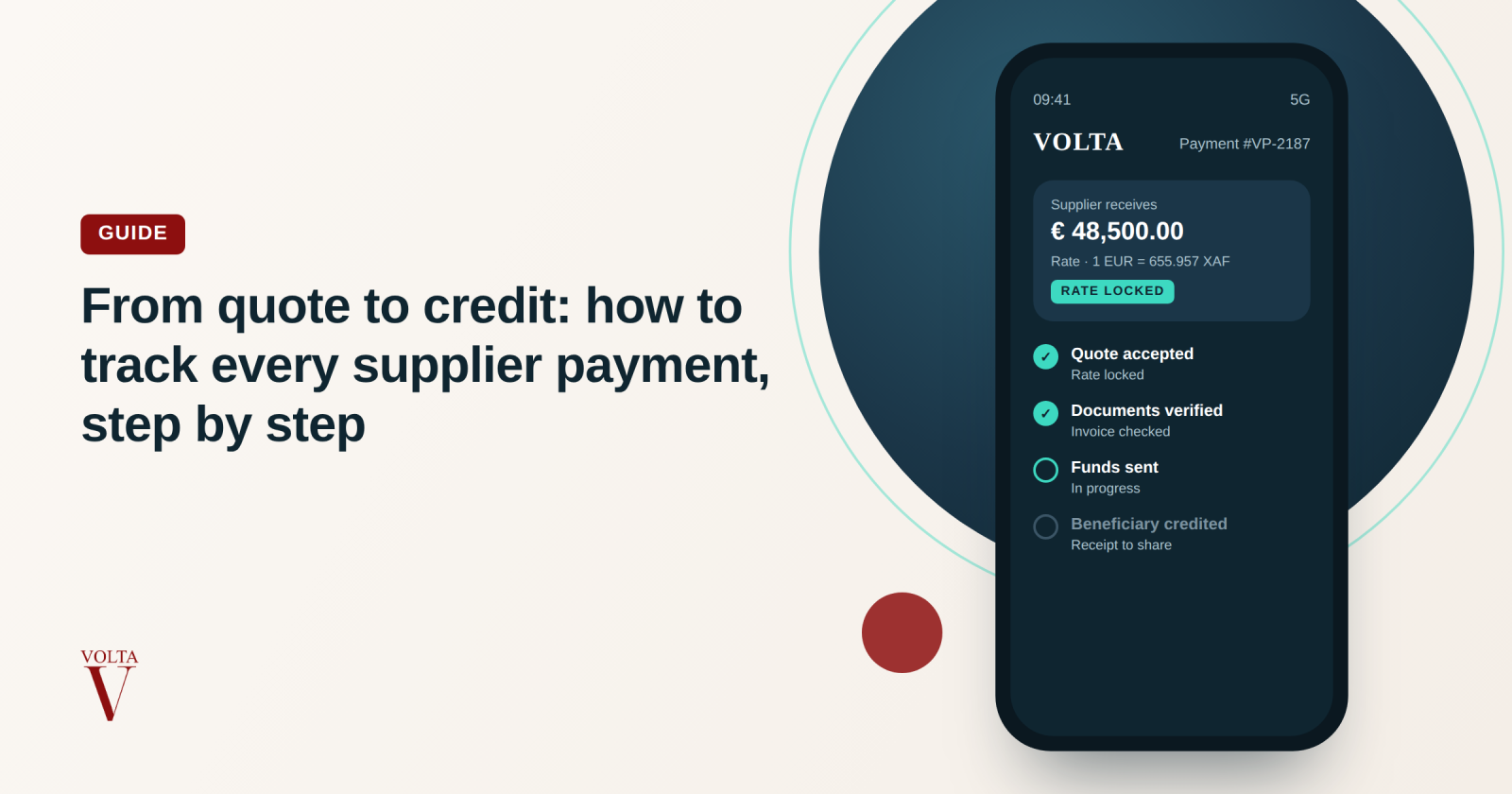
- Lock your rate. Currency movements between the moment you agree a price and the moment you pay can cost more than the fees. Use a provider that lets you lock a rate when you accept a quote.
How Volta helps
Volta was built for exactly this problem. Businesses get a clear quote showing the rate and fees before they commit, the rate is locked the moment they accept, and our team guides them through the documents their payment needs, from quote to settlement. Volta Square LLC is registered with FinCEN as a Money Services Business, and in Africa we work with licensed local payment partners.
Have a payment to make? Talk to our team or get started.
Sources
- Afreximbank, launch of the Pan-African Payment and Settlement System (PAPSS), 2022.
- Financial Stability Board, G20 targets for enhancing cross-border payments.
- Swift data on cross-border payment speed, as reported in 2026.
- FATF, statements on de-risking and correspondent banking.
- CEMAC Regulation No. 02/18/CEMAC/UMAC/CM of 21 December 2018 on foreign exchange, and BEAC circular of May 2021, as reported by Business in Cameroon.